
Comparison of blood lactate response between individuals with different 1RM test performance
DOI:
https://doi.org/10.31501/rbcm.v34i1.15119Keywords:
Performance, Lactate, StrengthAbstract
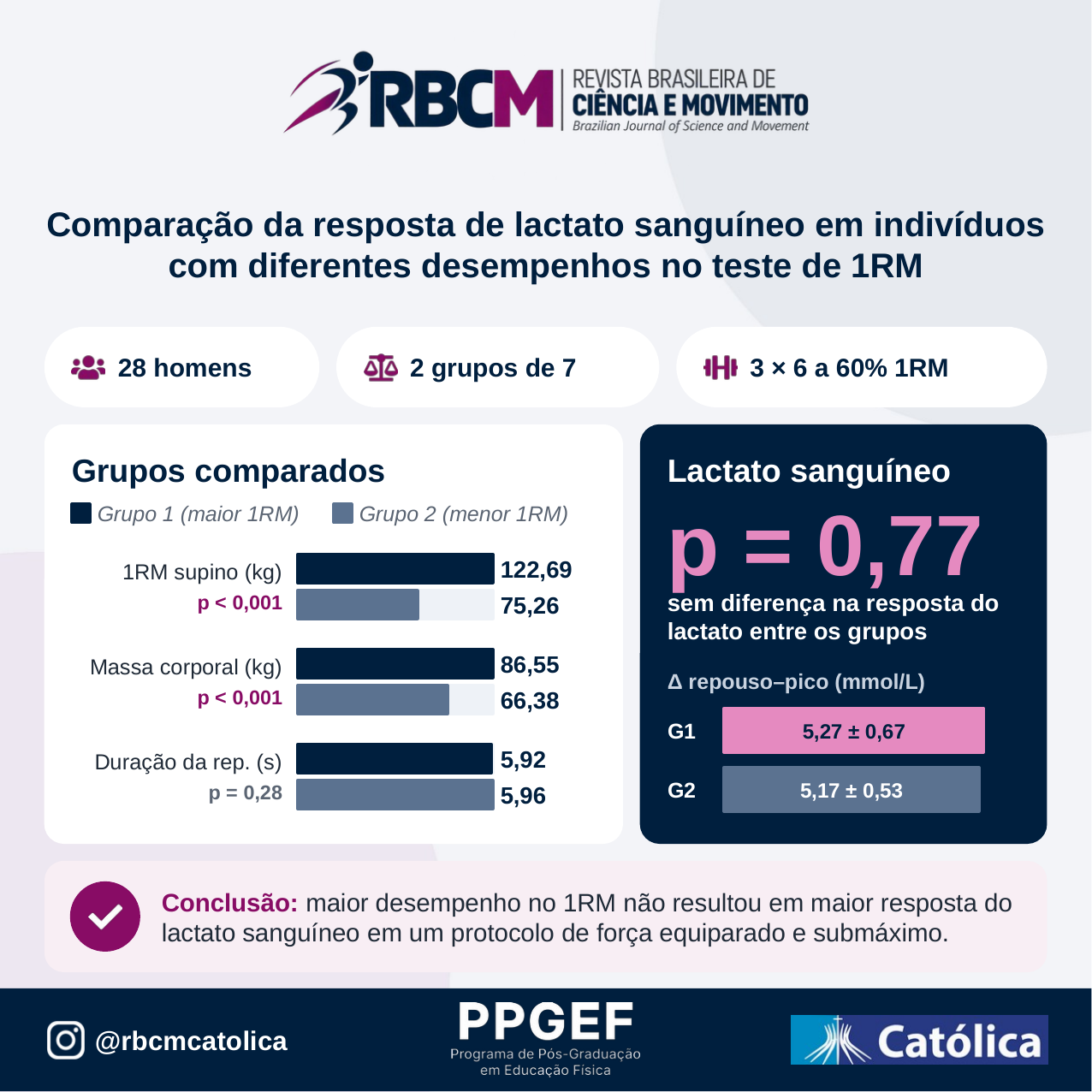
Previous research has often utilized blood lactate concentration as a key metric to compare metabolic responses to different strength training protocols across various contexts and demographics. However, despite these efforts, a conclusive understanding of the lactate response among individuals with different levels of maximal strength performance following similar training loads remains elusive. Thus, the primary aim of this study was to discern potential disparities in blood lactate concentrations among individuals exhibiting distinct performances in the one-repetition maximum (1RM) test. To address this objective, 28 men with at least six months of resistance training experience were recruited. They were divided into two groups based on their performance in the 1RM test: one group achieved the highest values of weight lifted during the guided bench press 1RM test, while the other group achieved the lowest values. Both groups then underwent a standardized training protocol involving the guided bench press exercise. This protocol consisted of three sets of six repetitions, with a 180-second rest interval between sets, all conducted at an intensity equivalent to 60% of their individual 1RM. Blood lactate concentrations were measured at eight time points throughout the procedure, including pre-, intra-, and post-protocol periods. Statistical analysis revealed no significant differences in blood lactate concentration responses between the two groups (p = 0.77). These results suggest that individuals with different performances in the 1RM test tend to exhibit comparable blood lactate concentration responses when exposed to equivalent training loads. In conclusion, this study provides valuable insights into the relationship between individual performance levels in strength assessments and subsequent metabolic responses. Such knowledge has implications for optimizing training strategies tailored to diverse populations within the field of strength and conditioning.
Downloads
Downloads
Published
Issue
Section
License
Copyright (c) 2026 Gustavo Ferreira Pedrosa, Arthur Brum Gonçalves Bischoff, Rodrigo César Ribeiro Diniz, Sara Andrade Rodrigues, Mauro Heleno Chagas, Fernando Vitor Lima, Diego de Alcantara Borba, Lucas Túlio de Lacerda

This work is licensed under a Creative Commons Attribution-NonCommercial 4.0 International License.
Os autores mantêm os direitos autorais de seus artigos. Ao publicar na Revista Brasileira de Ciência e Movimento (RBCM), os autores concedem à revista o direito de primeira publicação, bem como o direito de reproduzir, distribuir e disponibilizar o trabalho. Os artigos são publicados sob a Licença Creative Commons Atribuição-NãoComercial 4.0 Internacional (CC BY-NC 4.0). A licença permite o compartilhamento e a adaptação do trabalho para fins não comerciais, desde que sejam atribuídos os devidos créditos aos autores, indicada a RBCM como fonte da publicação e identificadas eventuais alterações realizadas.