
COMPARISON OF THE EFFECT OF IMMERSION AND ISOMETRIC EXERCISE ON HEART RATE VARIABILITY MEASURED BY A HEART RATE MONITOR AND A SMARTPHONE
DOI:
https://doi.org/10.31501/rbcm.v34i1.15185Abstract
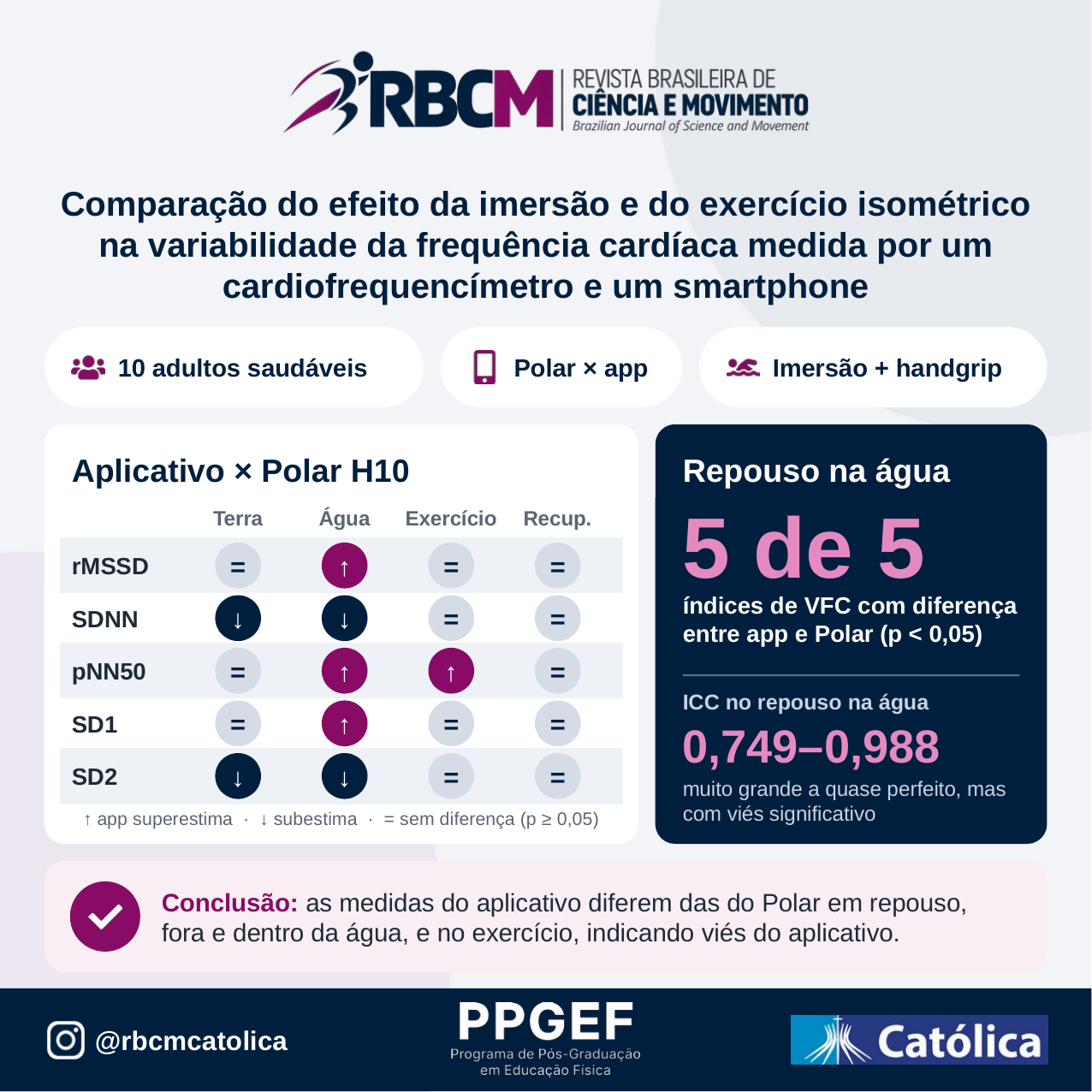
The study of the use of smartphone applications to measure biomarkers such as heart rate variability has been important due to the accessibility that these devices offer to the general population. However, they need to be tested so that they can be manipulated and interpreted correctly. Therefore, the objective of this study was to compare heart rate variability values obtained from a heart rate monitor and a smartphone application, during immersion with and without isometric handgrip exercise. Ten healthy adults of both sexes participated in the study. Maximum isometric manual strength was measured. They then remained at rest, sitting in an airy room for 15 minutes. Afterwards, they also remained at rest in the water immersed up to the height of the xiphoid process for ten minutes with their dominant arm resting outside the water. Next, participants performed 14 minutes of isometric exercise with their dominant hand, keeping their arm extended alongside their torso, in the water. Finally, they moved to the room again and remained seated for another 10 minutes of recovery. RR intervals were measured at all times and simultaneously with the Polar H10 chest strap and the HRV Camera application (ECG for Everybody) using a Motorola G6 Play smartphone. Paired Student's t-test was used to compare data between Polar and the moment-to-moment application. Bland-Altman plots and the intraclass correlation coefficient (ICC) were used to analyze the agreement between HRV measurement methods. Significant differences were found for all variables analyzed in at least one of the moments. Indicating bias in the measurements made by the application, so more research is needed to help improve these applications, making them increasingly accurate.
Downloads
Downloads
Published
Issue
Section
License
Copyright (c) 2026 Jhennifer Carolina de Almeida Alves, Alexandre Konig Garcia Prado

This work is licensed under a Creative Commons Attribution-NonCommercial 4.0 International License.
Os autores mantêm os direitos autorais de seus artigos. Ao publicar na Revista Brasileira de Ciência e Movimento (RBCM), os autores concedem à revista o direito de primeira publicação, bem como o direito de reproduzir, distribuir e disponibilizar o trabalho. Os artigos são publicados sob a Licença Creative Commons Atribuição-NãoComercial 4.0 Internacional (CC BY-NC 4.0). A licença permite o compartilhamento e a adaptação do trabalho para fins não comerciais, desde que sejam atribuídos os devidos créditos aos autores, indicada a RBCM como fonte da publicação e identificadas eventuais alterações realizadas.