American football in Brazil: body profile and athlete performance
DOI:
https://doi.org/10.31501/rbcm.v34i1.16122Keywords:
American football, Sports performance, Anthropometry, Descriptive analysis, Brazilian athletesAbstract
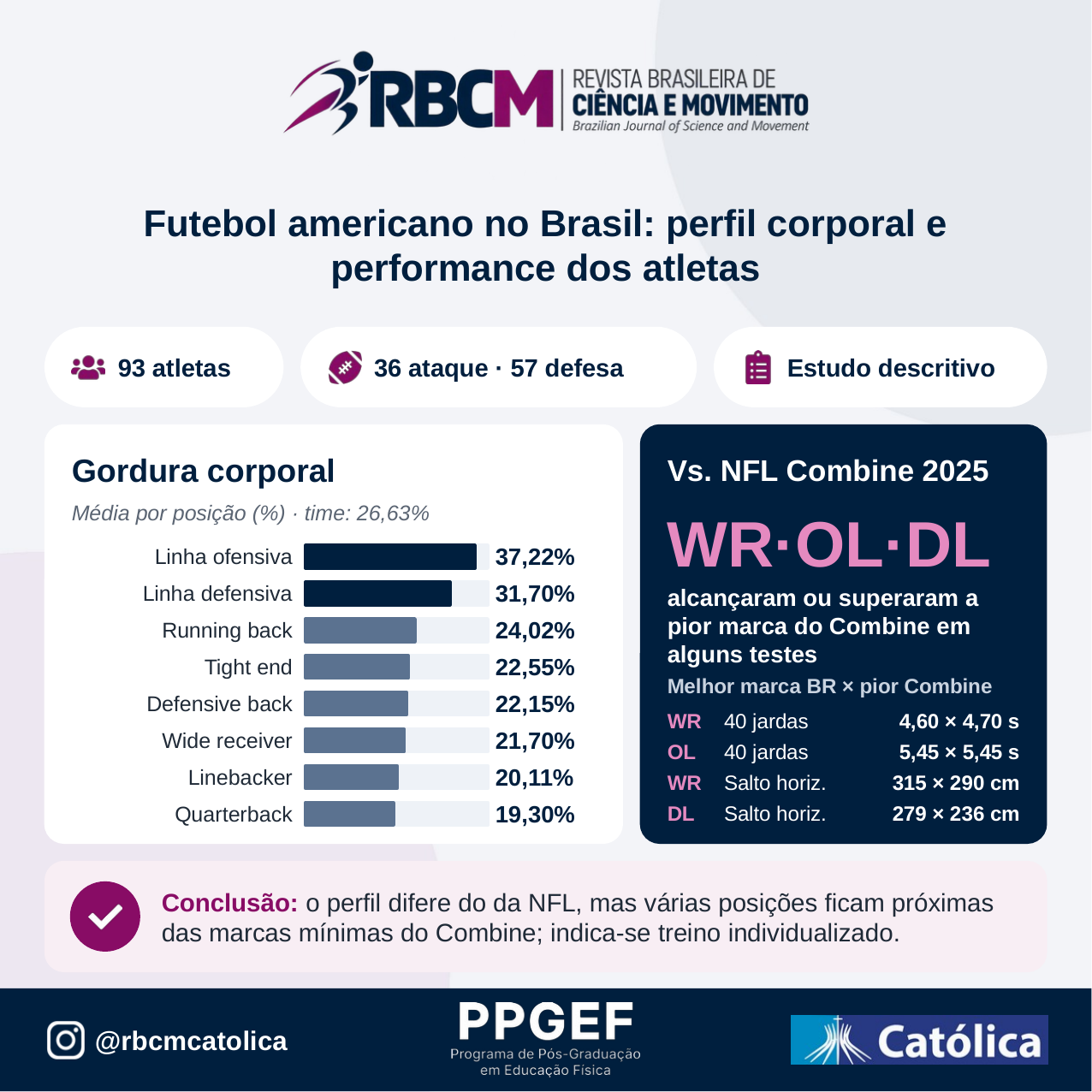
This study aimed to describe the anthropometric profile and physical performance of athletes from Flamengo Imperadores, an amateur American football team from Rio de Janeiro, based on data collected during the 2025 preseason Try-In. Body composition variables (body mass, height, body fat percentage, and lean mass) and performance in specific tests (40-yard dash, horizontal jump, vertical jump, 3-cone drill, 20-yard shuttle, reach test, and push-ups) were assessed. Results were compared with reference averages from the Tennessee Titans — the NFL team with the poorest performance in 2024 — as well as with the best and worst marks recorded at the 2025 NFL Combine. A total of 93 athletes participated, distributed among offensive and defensive positions. Despite structural differences, particularly in height, body mass, and lower-limb power between professional and amateur athletes, some positions showed performances close to or even exceeding the lowest NFL Combine marks, especially WR, OL, and DL in specific tests. Body composition results revealed high body-fat percentages among linemen and substantial variability across tactical roles. These findings enhance the understanding of the Brazilian American football athlete profile and provide relevant insights for physical preparation and performance monitoring strategies.
Downloads
Downloads
Published
Issue
Section
License
Copyright (c) 2026 Carlos Eduardo Pessanha Boller, Breno Noronha dos Santos, Marcelo Pintor Ferreira Coelho, Eliana da Silva Pereira, Julliana Mano Piva

This work is licensed under a Creative Commons Attribution-NonCommercial 4.0 International License.
Os autores mantêm os direitos autorais de seus artigos. Ao publicar na Revista Brasileira de Ciência e Movimento (RBCM), os autores concedem à revista o direito de primeira publicação, bem como o direito de reproduzir, distribuir e disponibilizar o trabalho. Os artigos são publicados sob a Licença Creative Commons Atribuição-NãoComercial 4.0 Internacional (CC BY-NC 4.0). A licença permite o compartilhamento e a adaptação do trabalho para fins não comerciais, desde que sejam atribuídos os devidos créditos aos autores, indicada a RBCM como fonte da publicação e identificadas eventuais alterações realizadas.