
The paradox of running shoe cushioning: a narrative review of technologies and biomechanical impact
DOI:
https://doi.org/10.31501/rbcm.v34i1.15568Keywords:
Footwear, Biomechanics, Running injuryAbstract
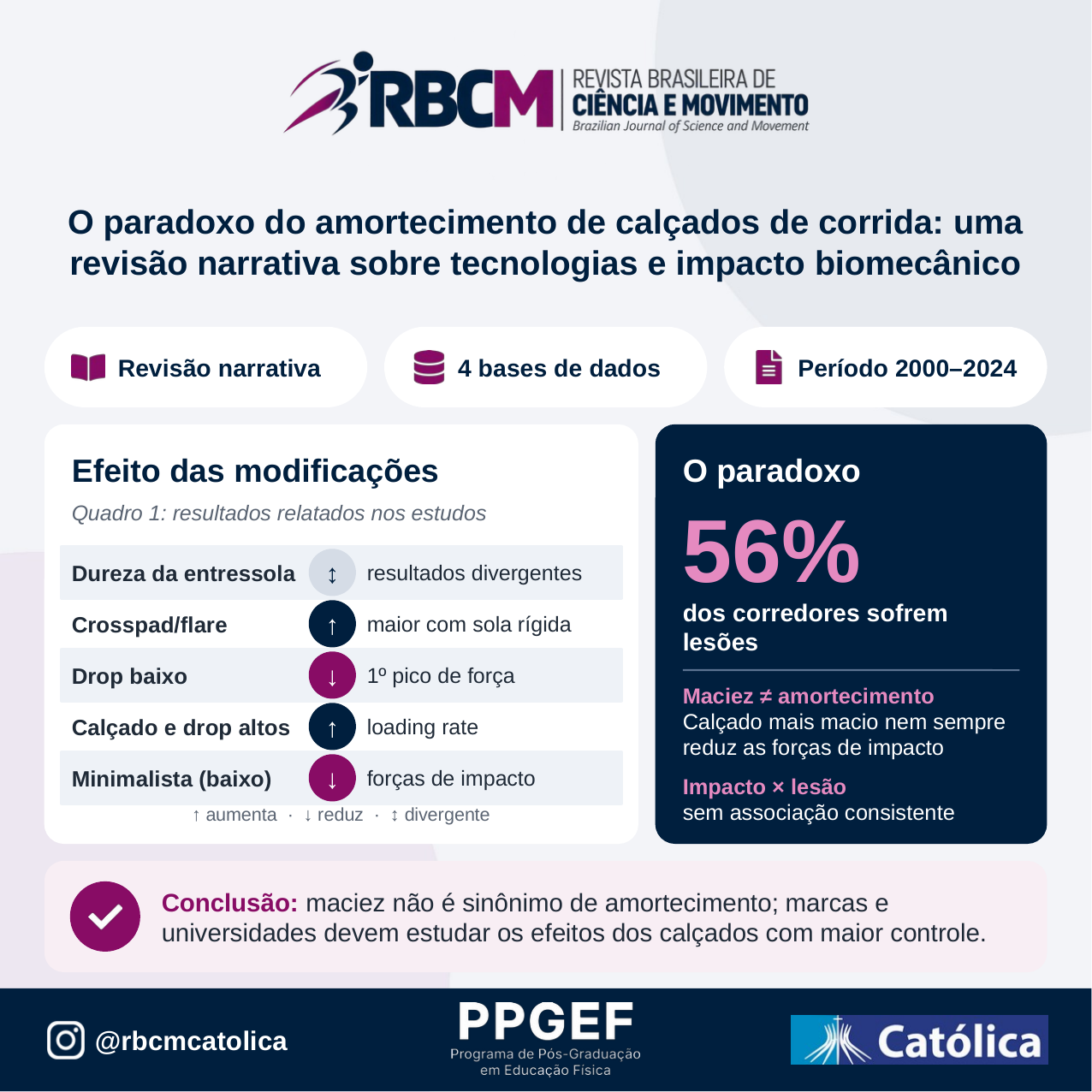
This review presents the current state of running shoe technologies, highlighting the evolution of materials and their properties over time. Biomechanical analysis considers the loading rate as an important measure of body cushioning, although there are divergences regarding the relationship between shoe stiffness and this rate. Some studies suggest that stiffer shoes can decrease the loading rate, while others indicate the opposite. However, it is unclear whether this relationship is true and whether it is directly linked to injury risk. The body adapts with running experience, but these adaptations are disregarded in most studies. Additionally, various modifications have been made to running shoes over time to try to reduce loads during running, including changes in design, materials, and cushioning. However, the results of these modifications are varied and often inconclusive. Finally, the complexity of the interactions between running shoes, the human body, and related sports injuries is highlighted, emphasizing the need for more rigorous and collaborative research between universities and companies to better understand these relationships.
Downloads
Downloads
Published
Issue
Section
License
Copyright (c) 2026 Wagner Rosa de Oliveira, Jeferson Fagundes Loss

This work is licensed under a Creative Commons Attribution-NonCommercial 4.0 International License.
Os autores mantêm os direitos autorais de seus artigos. Ao publicar na Revista Brasileira de Ciência e Movimento (RBCM), os autores concedem à revista o direito de primeira publicação, bem como o direito de reproduzir, distribuir e disponibilizar o trabalho. Os artigos são publicados sob a Licença Creative Commons Atribuição-NãoComercial 4.0 Internacional (CC BY-NC 4.0). A licença permite o compartilhamento e a adaptação do trabalho para fins não comerciais, desde que sejam atribuídos os devidos créditos aos autores, indicada a RBCM como fonte da publicação e identificadas eventuais alterações realizadas.