
Assessment of hip stability in street runners
DOI:
https://doi.org/10.31501/rbcm.v34i1.15711Keywords:
Athletes, Running, Hip, Biomechanics, Hip injuriesAbstract
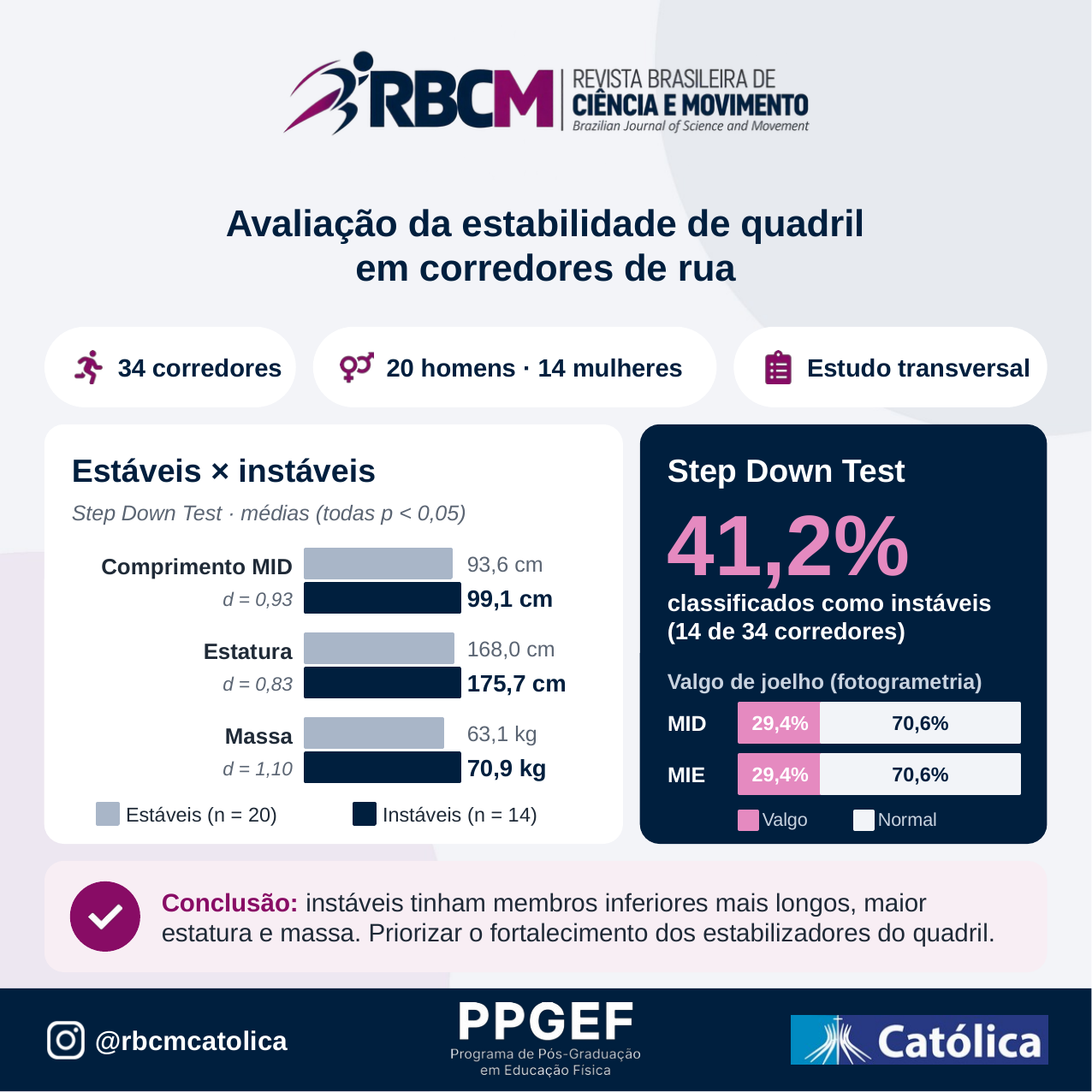
Running is a common form of exercise, yet it has a high prevalence of injuries, especially related to joint and muscle imbalances in the hip. The main objective of this study was to investigate hip stability in street runners. The research was quantitative and characterized as a cross-sectional observational study with voluntary random sampling. Thirty-four street runners of both sexes participated, aged between 18 and 65 years. Participants initially completed a sociodemographic questionnaire and the HAGOS Questionnaire to assess hip pain and discomfort. They underwent the Step Down Test to evaluate hip stability, Y Balance Test and HOP Test to assess lower limb asymmetries and functional instability, and photogrammetry for static posture analysis, Q angle measurement, and determination of valgus, varus, or normal alignment. The main results showed a low prevalence of valgus (29.4%). In the Step Down Test, 58.8% of runners were stable and 41.2% unstable. In the Y Balance Test, greater difficulty was observed in the right anterior (66.0±7.0 cm) and left (66.2±8.0 cm)movements. Valgus alignment in the left lower limb correlated with the HOP Test, indicating that participants achieved greater distances in the left unilateral jump (p=0.005) and left triple jump (p=0.039). Finally, significant differences were found in anthropometric variables of lower limb length, height, and mass concerning the classification of stable and unstable runners (p<0.05).
Downloads
Downloads
Published
Issue
Section
License
Copyright (c) 2026 Suelen Spadari, Natalia Mendes Maia, Wagner Rosa de Oliveira, William Dhein, Gisele Oltramari Meneghini

This work is licensed under a Creative Commons Attribution-NonCommercial 4.0 International License.
Os autores mantêm os direitos autorais de seus artigos. Ao publicar na Revista Brasileira de Ciência e Movimento (RBCM), os autores concedem à revista o direito de primeira publicação, bem como o direito de reproduzir, distribuir e disponibilizar o trabalho. Os artigos são publicados sob a Licença Creative Commons Atribuição-NãoComercial 4.0 Internacional (CC BY-NC 4.0). A licença permite o compartilhamento e a adaptação do trabalho para fins não comerciais, desde que sejam atribuídos os devidos créditos aos autores, indicada a RBCM como fonte da publicação e identificadas eventuais alterações realizadas.