Use of transcranial direct current stimulation to increase maximal strength, muscular endurance, and reduce perceived exertion in strength exercise in healthy adults: a narrative review
DOI:
https://doi.org/10.31501/rbcm.v34i1.15698Keywords:
Transcranial direct current stimulation, Muscle strength, Muscle fatigue, Physical performanceAbstract
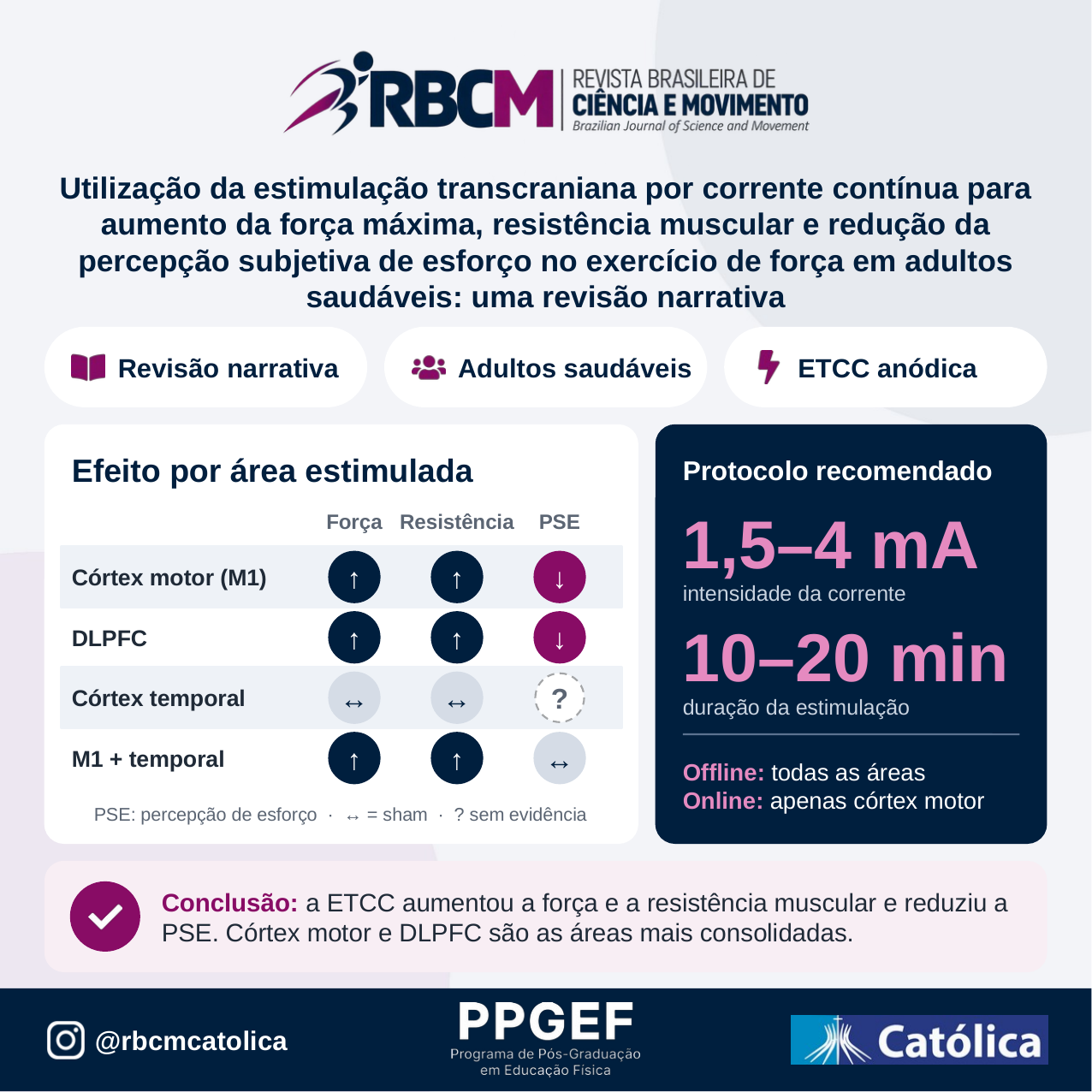
Transcranial direct current stimulation (tDCS) is a non-invasive strategy that induces performance gains in strength, aerobic exercise or sports. tDCS operates through two electrodes: anodal (depolarize) and cathodal (hyperpolarize). Therefore, the area of the electrode’s placement is relevant to the selected outcome. In this sense, to optimize the use of tDCS in strength training, it is necessary to establish the area where the electrodes will be positioned, as well as the amperage, duration, and timing of the tDCS. The objective of this narrative review was to explore the use of tDCS in different areas of the brain regarding maximal strength, muscular endurance, and rate of perceived exertion during strength exercise. We recommend that tDCS should be applied to the motor cortex, dorsolateral prefrontal cortex, and simultaneously in the motor and temporal cortex to enhance muscle strength, muscular endurance, and reduce rate of perceived exertion. The recommended duration for tDCS varies between 10 and 20 minutes, with an amperage of 1.5 to 4 mA, applied either online or offline. Cathodal electrodes can be positioned cortically and extracortically, for example, on the shoulders. Future studies may explore the application of tDCS in different areas and contexts in strength training and sports.
Downloads
Downloads
Published
Issue
Section
License
Copyright (c) 2026 Lucas Rangel Affonso de Miranda, Thales Couto Bergantini, Carlos Brendo Ferreira Reis, Lenice Brum Nunes, Luciana Carletti, Richard Diego Leite

This work is licensed under a Creative Commons Attribution-NonCommercial 4.0 International License.
Os autores mantêm os direitos autorais de seus artigos. Ao publicar na Revista Brasileira de Ciência e Movimento (RBCM), os autores concedem à revista o direito de primeira publicação, bem como o direito de reproduzir, distribuir e disponibilizar o trabalho. Os artigos são publicados sob a Licença Creative Commons Atribuição-NãoComercial 4.0 Internacional (CC BY-NC 4.0). A licença permite o compartilhamento e a adaptação do trabalho para fins não comerciais, desde que sejam atribuídos os devidos créditos aos autores, indicada a RBCM como fonte da publicação e identificadas eventuais alterações realizadas.