Effect of relative age on the tactical behavior of soccer players of different age groups: a systematic review
DOI:
https://doi.org/10.31501/rbcm.v34i1.11385Keywords:
Soccer, Tactics, Tactical behaviorAbstract
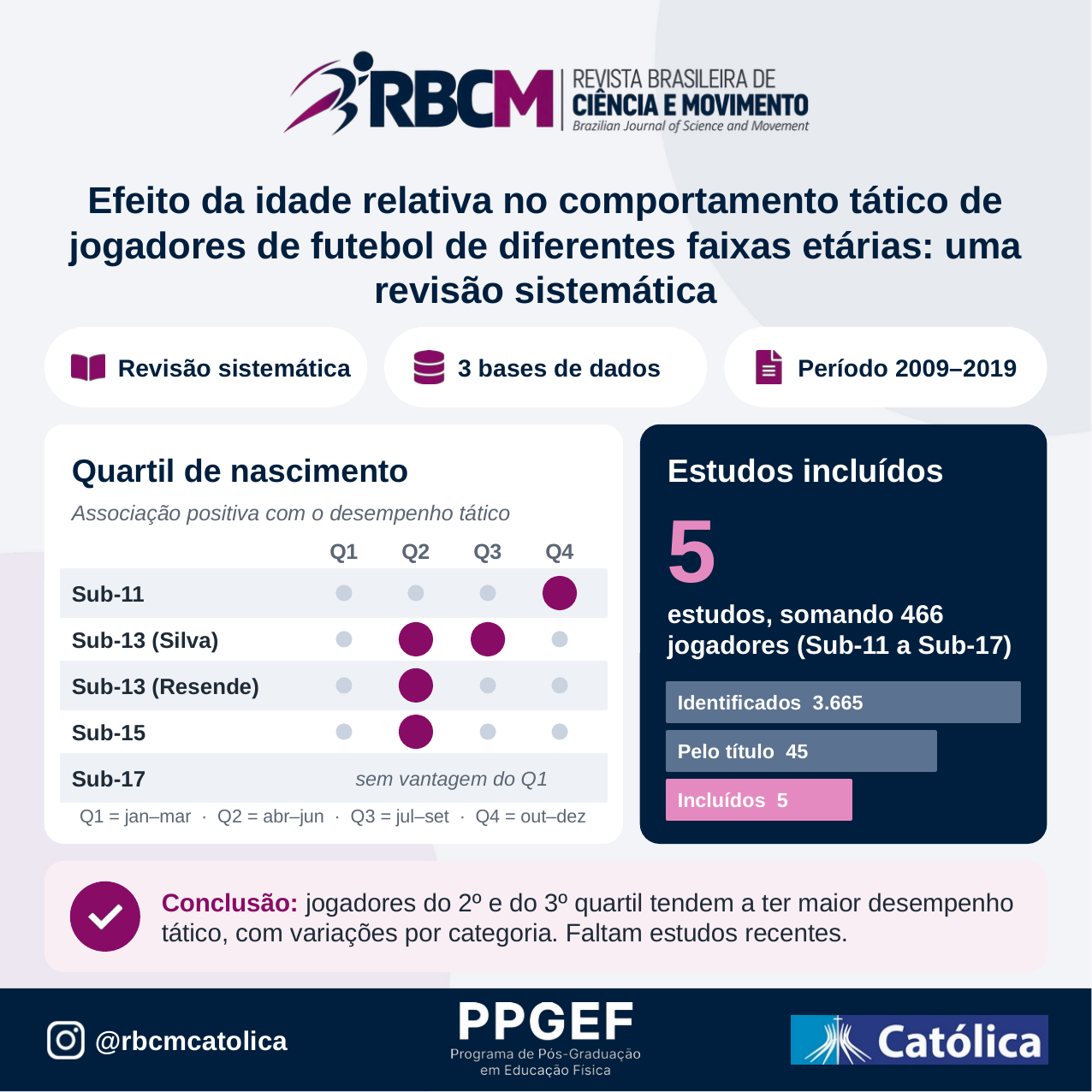
This study aimed to analyze, through a systematic review, the Relative Age Effect (RAE) on the tactical behavior of soccer players of different age groups. The research was conducted in different databases in the form of a systematic review. All studies found used the Football Tactical Assessment System (FUT-SAT) as a data collection and analysis instrument, a technology that offers the advantage of flexibility in the use of its categories and the quality of opponent interactions. The articles also observed the use of dividing the evaluated athletes by birth quartiles. During the analysis of the studies, it became evident that, according to the age group of the athletes, there are variations in the birth quartile of athletes who show a higher performance index for defensive or offensive tactical principles. These principles, specifically, also change according to the athlete’s category. It is concluded that the RAE with the specific addition of tactical behavior in soccer players is a recent phenomenon in the literature that requires a greater number of studies in different age groups, in order to allow for an even more comprehensive view of how to deal with this issue in the context of the evaluation and identification of talent in soccer.
Downloads
Downloads
Published
Issue
Section
License
Copyright (c) 2026 Revista Brasileira de Ciência e Movimento

This work is licensed under a Creative Commons Attribution-NonCommercial 4.0 International License.
Os autores mantêm os direitos autorais de seus artigos. Ao publicar na Revista Brasileira de Ciência e Movimento (RBCM), os autores concedem à revista o direito de primeira publicação, bem como o direito de reproduzir, distribuir e disponibilizar o trabalho. Os artigos são publicados sob a Licença Creative Commons Atribuição-NãoComercial 4.0 Internacional (CC BY-NC 4.0). A licença permite o compartilhamento e a adaptação do trabalho para fins não comerciais, desde que sejam atribuídos os devidos créditos aos autores, indicada a RBCM como fonte da publicação e identificadas eventuais alterações realizadas.